
I took this idea and ran with it, coming up with the general idea of attribute attacks. Any attribute can be the basis of an attribute attack; just like Mutant Future's Willpower attack, there are Intelligence, Dexterity, Constitution, Strength and Charisma attacks. I used this a lot while writing the "quirks" (mutations by another name) for my Fantasy Quirks character creation supplement for Mutant Future. I created a version of the Willpower Attack Table found in Mutant Future for any attribute attack:
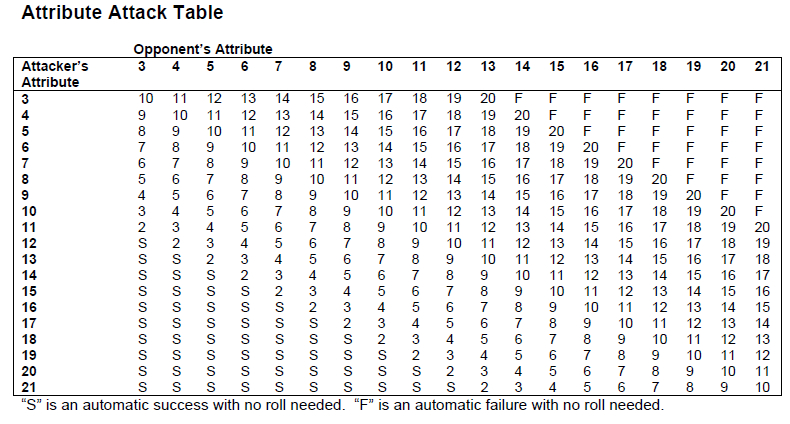
There are two things that I like about attribute attacks; they do not gain potency while leveling up unless the ability itself increases, so 1st level characters with high attribute scores can contribute meaningfully alongside high level characters in combat; and (more importantly to me) it makes each attribute a defense. It makes the random attribute increase that is the result of leveling up 80% of the time in the Mutant Future a much more valuable thing. In a similar fashion to how 3e and 4e took saves and made defenses out of them, this gives me as a DM an easy mechanic to use for all sorts of attacks against the PCs. Demonic possession? A Willpower attack with the demons WIL of 15. A run of the mill pit trap? Dexterity attack with an attacking DEX of 10. I would write the previous example using the following shorthand: DEX10 ATT 3d6 (meaning if the Dexterity attack succeeds against the character, the character takes 3d6 damage).
A cloud of gas? CON15 ATT, 5d6 dmg save for 1/2
Bribing an official? Obviously a Charisma attack situation. I don't always (or even most of the time) call for rolls when players attempt to do things, but it is nice to have an easy and unified mechanic to use when I do. When I don't know the attribute of a creature or situation (in the case of a pit trap or other inanimate attacker or target), I generally use 5/10/15+ as a good guide: If the creature is not known for that attribute, or if the challenge is easy, I use 5. If the creature has no reputation for that attribute, good or bad, or if the challenge is moderately difficult I use 10 as the target attribute. For a creature known for the attribute in question or a difficult challenge, I will use 15 or more.
Today, I looked at the chart a little closer and realized that I could express the attack resolution in very simple terms to allow attribute attacks on the fly without having to look up a target number on a chart.
I realize that many people love looking up numbers on charts. In my case, it is often one of the only times I have to refer to a book at all while running my Mutant Future game, and I would just as soon not have to break my stride to look at the attribute attack chart one more time.
So here it is:
The “Target 10TM” system for chart-less attribute attack resolution .
(Target 10TM Carl Nash 2010)
d20 roll + (Attackers Attribute - Defenders Attribute) ≥ 10 = Success
In words: Subtract the defender’s attribute from the attackers attribute. The result (positive or negative) is the modifier to the d20 roll. A modified result equal to or greater than 10 is a success.
Example:
An attacker with CON 13 makes a CON attack on a defender with CON 15.
Attacker’s CON - Defender’s CON = -2
-2 is the modifier to the d20 roll
The attacker would have to roll a 12 or better (12-2=10)
d20 roll + (Attackers Attribute - Defenders Attribute) ≥ 10 = Success
In words: Subtract the defender’s attribute from the attackers attribute. The result (positive or negative) is the modifier to the d20 roll. A modified result equal to or greater than 10 is a success.
Example:
An attacker with CON 13 makes a CON attack on a defender with CON 15.
Attacker’s CON - Defender’s CON = -2
-2 is the modifier to the d20 roll
The attacker would have to roll a 12 or better (12-2=10)


